


This flavor—and this atmosphere—will have you hooked.
3 Sapporo Chinese Restaurants That Are Delicious Right Now TEXT/REINA ABE, PHOTO/NAOKO TAKAHASHIIt’s a flavor you simply can’t recreate at home. Behind their approachable storefronts, these Chinese restaurants are packed with the kind of dedication only a specialist can bring. From classic staples to dishes you won’t find anywhere else, personality shines through in both the menu and the seasoning. Another welcome point: you get to enjoy a wide range of ingredients, from vegetables to seafood to meat. The three restaurants introduced here are beloved local institutions of Chinese cuisine. Why not visit one during Golden Week when the whole family is together, or on a weekend, to fill both your stomach and your heart?
Authentic flavor, just 2 minutes from the station.
Gyokurin Shuka
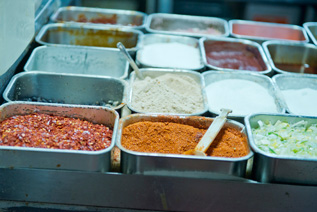
"Pretty flashy, right?" says manager Nakai with a laugh, gesturing around the gold-accented interior. The next moment, he's calling out orders to the kitchen in fluent Chinese. The cooks, who all have kind faces, are every one of them from China—and needless to say, all highly skilled. Everyone aligns on stir-frying technique and seasoning, and whenever a new cook joins, it reportedly takes over a month to fully train them in the restaurant's flavors. Every dish has been tasted and fine-tuned repeatedly by Nakai himself. The guiding principle: go easy on the spices that Japanese diners tend to find challenging, while still keeping the authentic flavor intact. To protect that authenticity, he makes a point of traveling to China three to five times a year to source ingredients and seasonings, and to eat his way through various restaurants to stay on top of trends in Chinese cuisine.
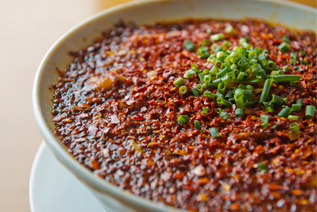

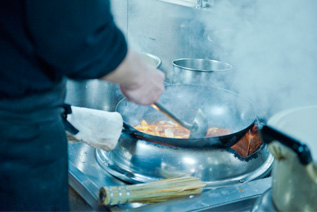
The key is heat control and speed. Colorful ingredients fly busily back and forth between wok and air. Finished with a drizzle of hot chili oil, the "Spicy Soup (La Tang)" arrives with the whole bowl blazing red. It looks fiery, and one sip confirms it—it really is intensely spicy. But savory depth emerges from underneath, and you can't stop eating it. It's said to be a foundational dish of Sichuan cuisine, something like what miso soup is to Japanese food. There's also "Qingjiao Rousi" (shredded pork with green pepper), with its pleasantly crisp bell pepper texture, and the aptly named "Bouncy Fried Shrimp," where the shrimp practically pop in your mouth. Every dish here has a distinctive deliciousness quite different from the Chinese food you're used to.
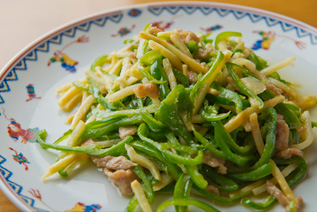
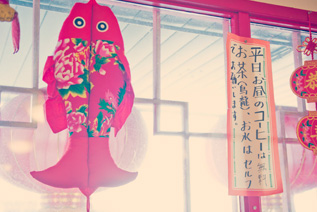
The spacious dining room is filled here and there with hand-drawn menus complete with illustrations, brightly colored decorations all sourced in China, everyone's beloved pandas, and paintings by folk artists from Xi'an and Shanghai. All that lively energy feels like a warm welcome from the restaurant as a whole, and it gets your appetite going too. The staff clearly play a big role as well, always keeping an eye on the room's mood and casually telling customers, "Feel free to ask for more rice." Ask around, and you'll hear the restaurant's concept is "recreating an everyday Chinese neighborhood eatery." True to that concept, it's a place with an unpretentious warmth and deliciousness all its own.
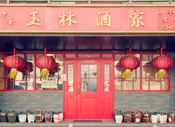
玉林酒家
札幌市東区北43条東16丁目1-10
TEL.011-784-5668
Hours/Lunch 11:00–14:00
Dinner 17:00–23:00
Closed/1st and 3rd Mondays
Generous portions, satisfying flavor.
Bokkai Hanten
The sound of a knife chopping cabbage. The sizzle of ingredients hitting hot oil. The clatter of a ladle against the wok. Pleasant sounds fill the kitchen at "Bokkai Hanten," a Chinese restaurant now in its sixteenth year. It's run by three people: owner-chef Lin Zhongsheng and his wife, along with Yamamichi, who handles the front of house. Lin began training as a cook at age sixteen, came to Japan in 1995 (Heisei 7), and honed his skills at a Chinese restaurant in Susukino before eventually going independent and opening Bokkai Hanten. A seasoned veteran, he holds China's national qualification of Tokkyu Chushi, Grade 2 (Special-Grade Chef, Level 2). With swift, practiced hands, he commands his gleaming black wok and ingredients with total ease.
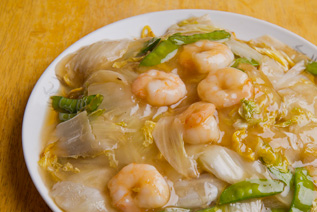

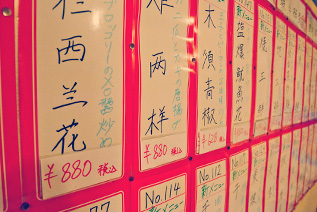
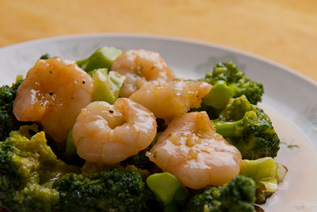
Though we call it "Chinese cuisine" as one thing, it's really broadly divided into Beijing, Shanghai, Sichuan, and Cantonese styles, each with its own origins and seasoning. Lin can cook all of them, but here he adapts his dishes for Japanese palates—and the menu runs to a remarkable 167 items. Menu item number 167, "Stir-Fried Shrimp and Broccoli in XO Sauce," is a dish where simple deliciousness really shines. The two lightly stir-fried ingredients have just the right bite, with the savoriness of seafood locked inside. "Shrimp Ankake Yakisoba" is a classic of classics—crispy noodles topped with plump shrimp and a gently salted thickened sauce that's utterly irresistible. You can choose from three types of noodles: pan-fried, boiled, or deep-fried. The recommended choice is the half-fried noodle, which keeps a touch of softness.
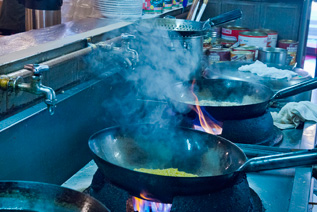
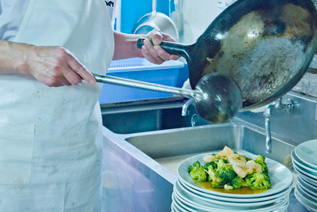
Both the rice and vegetables are Hokkaido-grown. Every ingredient is chosen and sourced personally by Lin, for freshness as well as value. Reasonably priced, quick, generously portioned, and with quality that's beyond question—naturally, customers keep the place busy nonstop. Office workers at weekday lunchtime, students in the evening, families on weekends. Plenty of what look like regulars, too—Yamamichi calls out to a man sitting alone, "The usual, then?" Orders arrive as a piping-hot dish that seems to come together effortlessly, but in the prep work, the precise timing of the heat, and every other small step, you sense there's careful technique and effort hidden away. Lin says he loves Hokkaido. No doubt he'll keep filling this spot with delicious Chinese food, and satisfied customers, for years to come.
渤海飯店
札幌市東区北16条東7丁目1-31 フロンティア16
TEL.011-742-7852
Hours/Lunch 12:00–15:00
Dinner 18:00–22:00
Closed/Tuesdays
It's not just about great gyoza.
Gyoza-kan
Your expectations get overturned—in the best possible way. There's far more here than just gyoza. With an easy-to-remember, straightforward name combining the familiar words "gyoza" and "kan" (hall), plus an extensive menu, it has the feel of a Chinese restaurant beloved by the local community. Manager and head chef Sudo hails from Tokyo and already has 35 years of experience under his belt. After graduating school and knocking on the doors of various restaurants looking for cooking work, he tried the bang bang chicken and yakisoba at one Chinese restaurant—and they were so delicious that he thought, if I could eat food this good every day, and committed himself to Chinese cuisine on the spot. He went on to become head chef at that very restaurant, a renowned establishment founded in the first year of the Showa era, before being invited to Sapporo through a connection. Building on the skills and sensibility he cultivated at that long-established restaurant, he now leads the kitchen guided by the principle of "how delicious can I make food at a price people can afford every day."
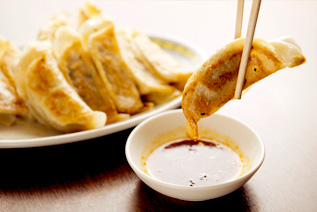
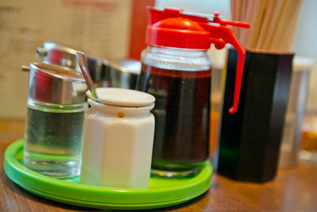
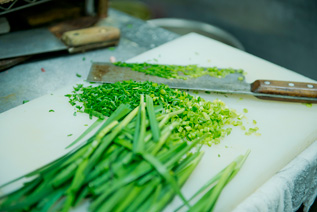
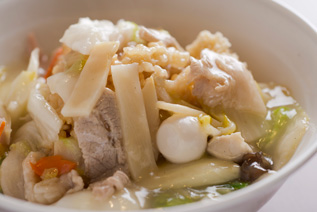
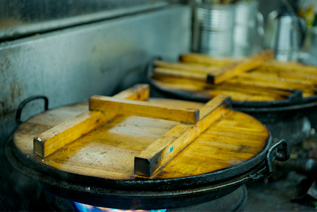
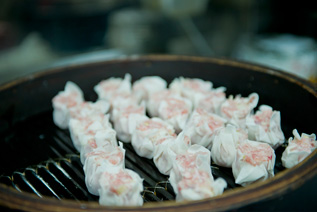
The signature "Pan-Fried Pork Gyoza" hasn't changed since the restaurant opened. The wrapper, made specially for Gyoza-kan by a noodle workshop, is on the thicker side. Rather than a simple steam-fry, it's cooked with plenty of water almost like simmering, giving the chewy wrapper and filling a really satisfying bite. There's also a "Vegetable-Packed Pan-Fried Gyoza," true to its name, which is said to be popular with women. Then there's the "Five-Ingredient Crispy Rice," which arrives at the table as two separate bowls—one piled with crispy rice, the other with a similarly hearty thickened sauce. When the two piping-hot elements meet, they let out an irresistible sizzle. It's a dish that delights the eyes, ears, and nose alike. Add a splash of vinegar partway through, and you get to enjoy how the flavor changes. The golden-brown crispy rice starts out satisfyingly crunchy, then gradually softens as it soaks up the sauce. The crispy rice is even made in-house—rice is pressed thin into a pot, then heated and dried. "You could even make it at home," they told us.
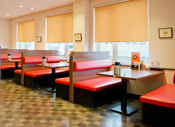
Gyoza-kan is located in Hassamu, an area lined with woodworking and ironworking industrial parks. It's only natural that the workers who sweat it out there put their trust in a restaurant that delivers on flavor, speed, and portion size all at once. As a result, men make up about 90% of the weekday lunch crowd. The portions, it seems, naturally grew larger over time so customers could eat their fill and keep up their energy through the afternoon. Even sales reps who make it a treat to look forward to when doing rounds in the Nishi Ward area are said to travel from far away to visit. The last dish we tried, bang bang chicken, had a deep, rich flavor. When we asked Sudo whether there was a story behind it, it turned out to be based on the flavor of that same long-established restaurant—the one whose food he once found so genuinely delicious. In that spirit, rather than chasing complicated seasoning, he faces simple deliciousness head-on, honestly. What awaits here is a dish brimming with the care poured into every bit of cooking.
餃子館
札幌市西区発寒8条14丁目5-6
TEL.011-666-2239
Hours/Tue–Fri
Lunch 11:00–14:30
Dinner 17:00–21:00
Sat, Sun, and public holidays
11:00–21:00
Closed/Mondays
Open on public holidays, closed the following Tuesday instead
tenshin-sapporo.com

関連する記事
-
Where the locals actually go.
5 Ramen Shops You Have to Try in Sapporo -
Stay in Sapporo, but let your mood travel abroad.
A Trip Abroad, Without Leaving the City -
When you're craving lamb, come here.
Sapporo’s Delicious Genghis Khan Restaurants -
Everyday lunch break bliss.
3 Great Lunch Sushi Spots in Sapporo
新着ピックアップ
-
A genuine flavor that has walked alongside Sapporo's history.
3 Long-Established Ramen Shops in Sapporo -
150 years, and still beloved.
Ganso Kaminari-yoke Shinko -
A new standard that goes beyond a boom.
3 Sapporo Soup Curry Restaurants We Secretly Want to Keep to Ourselves -
Watching over the neighborhood for half a century — Susukino's mom and pop.
Hachiya


